

Kim Mutaw's flies fish harder water than she does. From a vise in Southern California, her custom baitfish patterns ship out for giant trevally, golden dorado and roosterfish in places she has never stood — designed, on purpose, for one shot at a trophy fish.
It started with her dad. He taught her to fish when she was about six, and they spent decades on the water together — conventional gear, always. Fly fishing didn't show up until 2020, when her parents retired to Central Oregon and her dad surprised her with a guided trip on the Lower Deschutes. First time she'd ever stepped into a river with a fly rod, and she was hooked on the spot.
Then the pandemic shut the travel down, and her partner had an idea: tie flies to stay connected to it. Early 2021 she sat down at a vise with woolly buggers, zebra midges and Copper Johns, mainlining Tim Flagler tutorials. The obsession escalated the way it does — trout streamers, articulated flies, then big flies for pike and musky, learning from tiers like Gunnar Brammer along the way.
Somewhere in there the question changed from how do I tie this pattern to why does this fly work — design, materials, how a fly behaves in the water. That's what pulled her into baitfish imitations and the Popovics-style fleyes that define her tying now. In 2024 she tied her first Fly Fishing Show, in Pleasanton, sold a bunch of flies, and came home believing it could be a business. A website, then Shopify, then custom orders: The Flies That Bind.
Now she's production tying Beast Fleyes for the 2027 show season, her own Malware Minnow has become one of her most requested patterns, and customers send her photos of fish she can only dream about — caught on her flies. We sent her three questions. Here's Kim, in her own words.
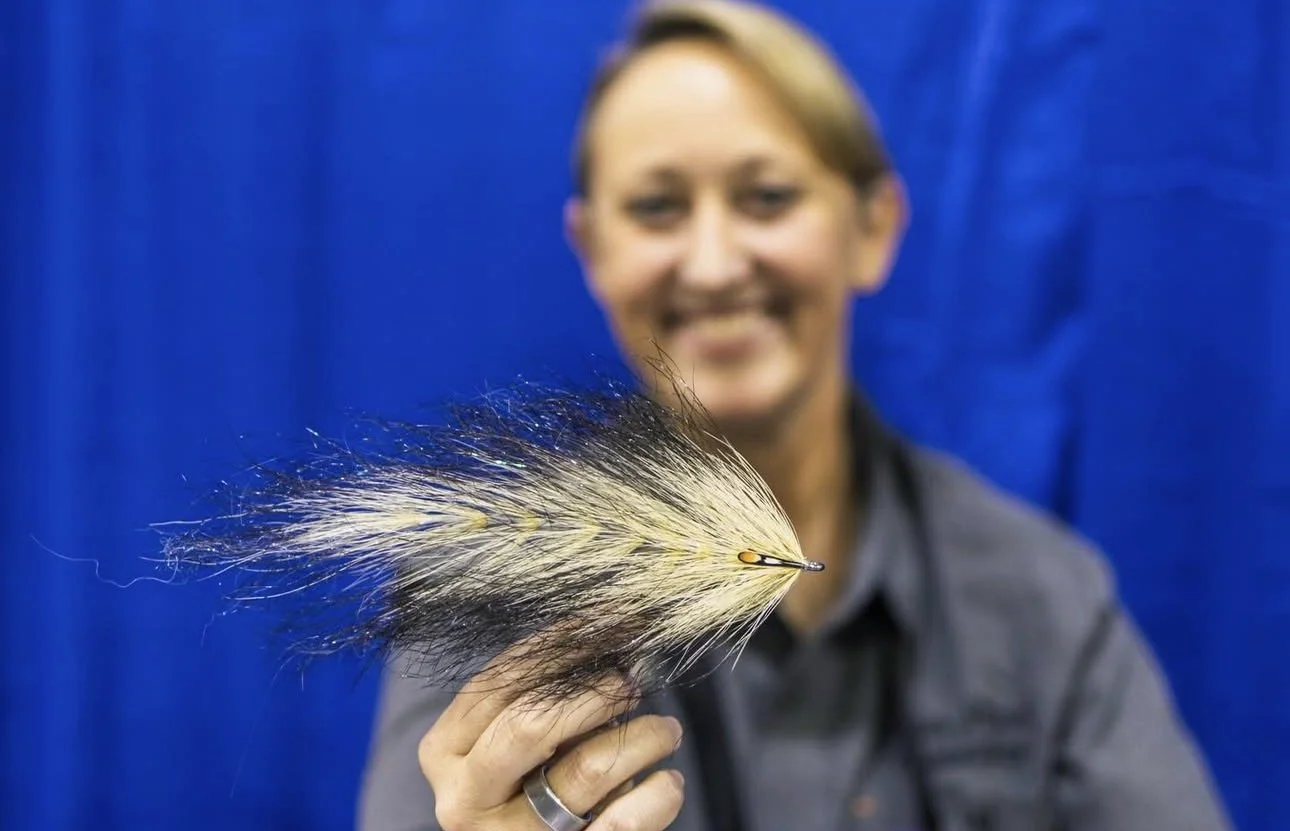
Kim Mutaw at a show, holding up one of her Beast Fleyes — this black-and-white one is tied with skunk tail, because she's never been afraid to reach for a lesser-known material when it's the right one for the fly.
How'd The Flies That Bind get started — were you tying for yourself first, and when did it turn into a real custom tying business with the Shopify shop and orders going out the door?
To tell the story of how The Flies That Bind got started, I really have to go back to my dad. He taught me to fish when I was about six years old, and we've spent decades making incredible memories together on the water, although it was always with conventional gear. When my parents retired to Central Oregon in 2020, my dad surprised me on my first visit with a guided fly fishing trip on the Lower Deschutes. We'd talked about trying fly fishing together for years, but neither of us had ever done it. I still remember stepping into that river, feeling the power of the water rushing around my legs, and suddenly feeling like a complete novice despite having fished my entire life. I was completely hooked. That trip was the beginning of my fly fishing journey, and as it turns out, the beginning of something much bigger.
Of course, 2020 also brought the pandemic, and suddenly traveling to see my parents and fishing the rivers I'd been dreaming about wasn't really an option. My partner suggested I try fly tying as a way to stay connected to fly fishing, even when I couldn't get out on the water with my dad. So, in early 2021, I bought some materials, sat down at a vise, and started tying woolly buggers, zebra midges, and Copper Johns. I was obsessed. I spent countless hours watching Tim Flagler's tutorials, practicing techniques, experimenting with materials, and trying to make each fly a little better than the last. Eventually, I started challenging myself with bigger and more complicated patterns: trout streamers, articulated flies, and eventually big flies for pike and musky, learning from tiers like Gunnar Brammer along the way.
Somewhere in that process, my interest shifted from simply learning how to tie a particular pattern to understanding why a fly works. I became fascinated with fly design, how different materials behave in the water, and how to combine them to create flies that are purpose-built for specific applications. That's really what led me toward baitfish imitations and the Popovics-style fleyes that have become such a big part of what I tie today. I love experimenting with natural and synthetic materials and figuring out how to get the movement, profile, and durability I'm looking for in a fly.
A couple of years ago, I started thinking that maybe I could turn this obsession into a little side hustle. Nothing crazy, just sell enough flies to cover my materials and hopefully let the hobby pay for itself. In 2024, I tied at my first Fly Fishing Show in Pleasanton, California. I was incredibly nervous, especially being surrounded by so many talented tiers whose work I admired. But I ended up selling a bunch of flies, and that experience gave me the confidence to believe that maybe I could actually make something of this. I launched a website, eventually transitioned to Shopify, and started taking custom orders. Before I knew it, The Flies That Bind had become a real little business.
The Fly Fishing Shows have honestly been one of the biggest factors in growing the business. You meet so many incredible people, and there's something special about being able to put a fly in someone's hands. They can see the craftsmanship, feel the materials, and appreciate the details that don't always translate through a photo on a website. I sell flies at the shows as well, and one of the most rewarding parts of this whole journey has been having customers come back to me for custom orders before their next fishing trip because they bought some of my flies at a show, took them out on the water, and caught fish with them. For someone who started tying flies just to feel a little more connected to fishing with her dad, that's a pretty incredible feeling.
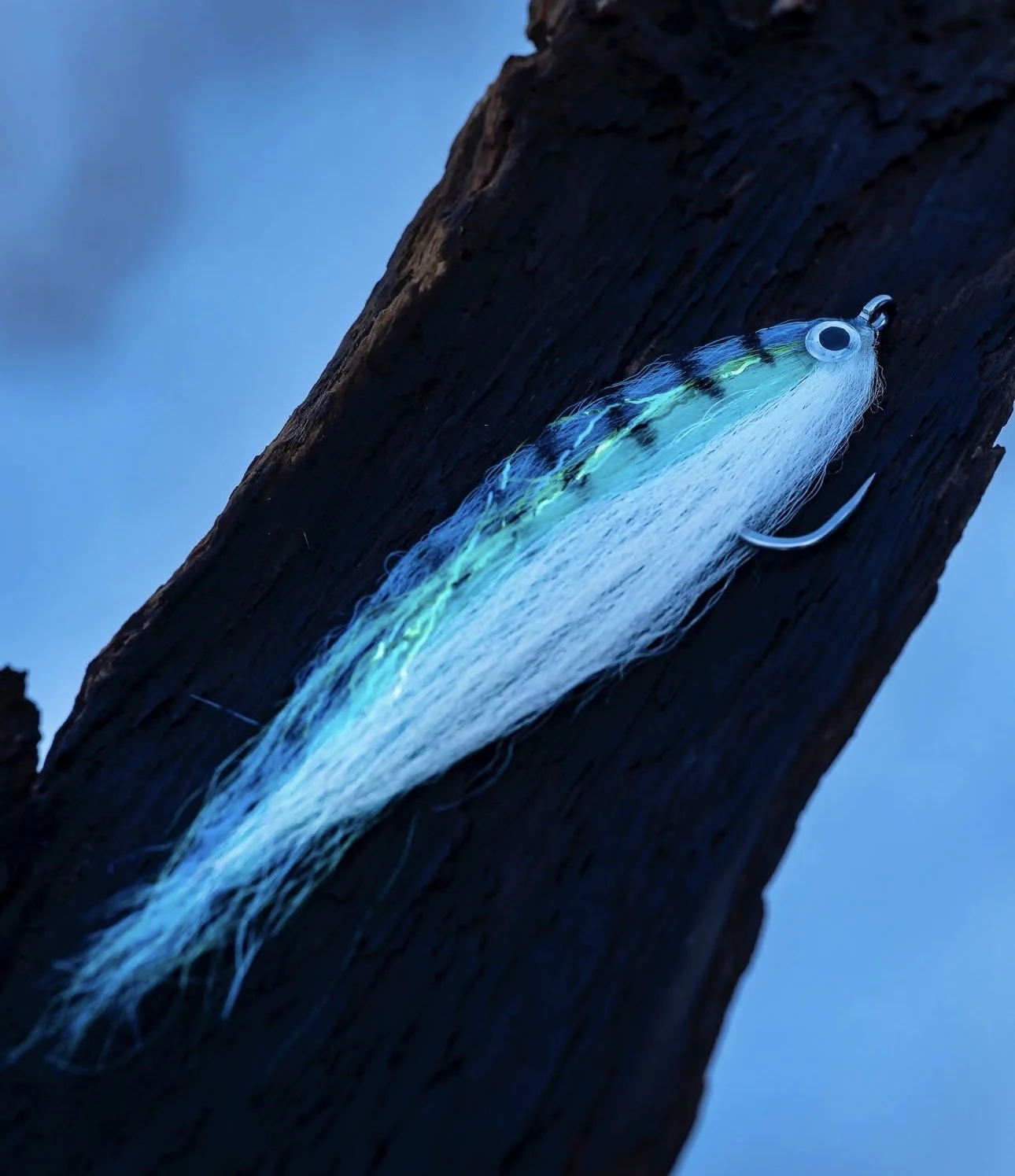
One of Kim's mackerel-style baitfish imitations — white belly, barred green-and-blue back, big baitfish eye — resting on driftwood. Patterns like this are the design work her second answer is about.
You're tying custom orders headed overseas for big fish, and your tutorials like the Nayat Mackerel show how much thought goes into those patterns — when someone orders flies for big fish on the other side of the world, how do you decide what to tie for water you may never fish yourself, and what are you tying most right now?
One of the really interesting challenges of custom tying is designing flies for fisheries I've never personally experienced. I was born and raised in Southern California, where I still live, and while we have a pretty incredible saltwater fishery in our own backyard, I haven't yet had the opportunity to chase giant striped bass, enormous GTs, or massive golden dorado. But honestly, that's part of what makes custom tying so much fun for me.
I always start by asking my customers a lot of questions. Most of them already have a pretty good idea of what they're looking for, either because they've fished that particular species or location before or because they've gotten recommendations from someone who has. Sometimes they know exactly what pattern they want, and my job is to bring that vision to life. Other times, they give me a little more creative freedom, and that's when I really get to dig into the design process.
I'll research the fishery, the target species, what they're feeding on, and how they hunt. All of that helps inform the decisions I make at the vise, from the overall profile and size of the fly to things like hook selection and placement. I want to understand not just what the fly needs to look like, but what it needs to do in the water. Every new species or fishery presents a different challenge, and figuring out how to translate what I've learned into a functional fly design is something I really enjoy.
In late 2024, I dove headfirst into the world of Pop Fleyes, initially because I wanted to challenge myself to master bucktail techniques while tying bigger patterns. What started as a learning exercise turned into a bit of an obsession, and that's really where my passion still lives today: big baitfish imitations designed for big predatory fish. There's something incredibly satisfying about understanding how different materials and tying techniques can work together to create the profile and movement you're looking for.
Right now, I'm preparing for the 2027 Fly Fishing Show season, so I've been spending a lot of time production tying Beast Fleyes, along with Bucktail Deceivers and Hollow Fleyes. I'm also tying quite a few of my own Malware Minnows, a synthetic baitfish pattern I developed that's become one of my most requested flies this year, particularly from anglers heading down to Mexico to chase roosterfish. I designed the Malware Minnow to imitate a wide variety of baitfish, and the combination of movement, durability, and versatility makes it a pattern that can be fished across a pretty broad range of fisheries. There's something pretty incredible about knowing that flies coming off my vise here in Southern California are making their way to fisheries around the world, especially places I hope to experience myself someday.
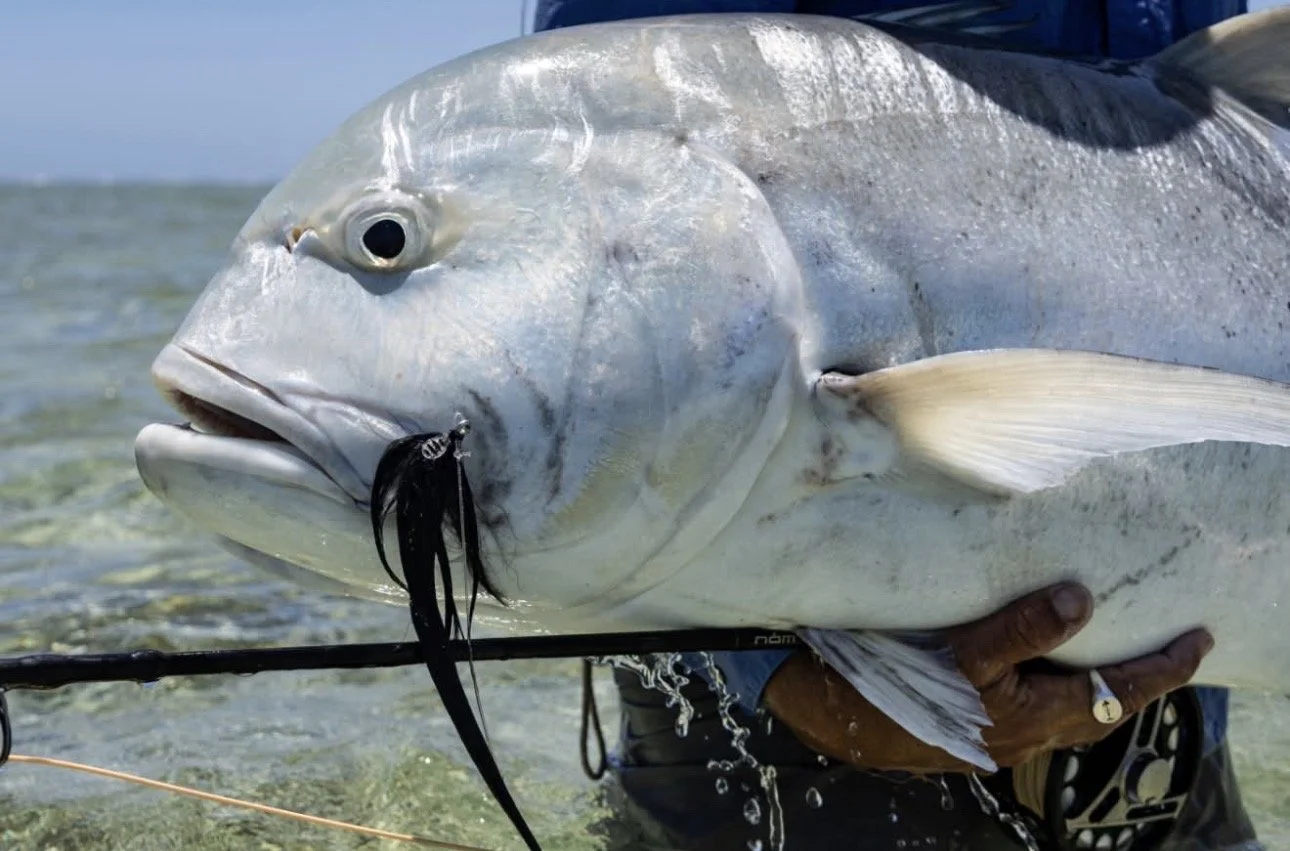
A giant trevally at the water's edge with one of Kim's black baitfish flies still in its jaw — a customer's fish, on a fly tied in Southern California for water she'd never fished.
You've got a full show season ahead and the YouTube channel growing alongside the tying — what are you building toward with The Flies That Bind, and what do you want people who find you through this to know about ordering custom flies from you?
What I'm really trying to build with The Flies That Bind is a business that's known for quality, thoughtfully designed flies that anglers can have confidence in, while also creating a place where I can share what I've learned and hopefully help other tiers along the way.
I feel like I get to live vicariously through my customers who are fortunate enough to take these bucket-list trips to incredible destinations, chasing fish I can only dream of catching someday. Knowing that someone might get just one shot at a trophy fish makes it incredibly important to me that the flies I put in their hands are durable, cast well, and swim the way they're supposed to. I can't tell you how much joy it brings me to wake up to an Instagram message from a customer with a huge smile and an even bigger fish that one of my flies helped them catch. Hopefully, one day I'll have one of those fish on the end of my own line, but until then, getting to be a small part of someone else's fish-of-a-lifetime experience is pretty incredible.
The other thing that's really important to me is giving back to the fly tying community by sharing the knowledge that so many great tiers have shared with me. One of the things I love most about this community is how generous people are with their knowledge, whether it's a tying technique, advice on getting a fly to swim better, or tips on sourcing quality materials. I've been incredibly fortunate to meet some amazing people through social media and the Fly Fishing Shows, and both have given me opportunities to learn from others and pay that knowledge forward. I learned to tie by watching countless hours of YouTube tutorials, so I know firsthand how valuable that kind of content can be. I'm starting to film more tying tutorials for my YouTube channel, and my goal is to make it a resource where people can learn new techniques, better understand materials, and hopefully become more confident at the vise.
I've got a busy 2027 show season ahead, and I'll be tying at the Athens, Edison, and Denver Fly Fishing Shows, with flies available for purchase at each stop. For anyone interested in custom flies, whether you know exactly what pattern you want or just have a destination and target species in mind, I'm always happy to talk through what you're looking for. You can browse some of my available flies and submit custom order inquiries through my website at thefliesthatbind.myshopify.com, email me directly at thefliesthatbind@gmail.com, or reach out through Instagram. And if you're attending one of the shows, please stop by and say hello. One of the best parts of doing this is getting to meet the people who share the same passion for fly fishing that I do.
The Fly Life take: Most custom tiers tie what they know. Kim Mutaw's whole business runs the other way — the order comes in for a fishery she's never seen, and the homework starts: what the fish eat, how they hunt, what the fly has to do, not just look like. Profile, size, hook selection and placement, all decided at a vise in Southern California for water on the other side of the world. That's a design discipline, and it's why her flies keep ending up in the jaw of fish she's only seen in customer photos.
The standard she ties to is the one worth stealing. A customer might get one shot at a trophy fish on a bucket-list trip, so the fly has to be durable, cast well, and swim right — no exceptions because she won't be there to hand them a spare. And the same tier who learned from free YouTube tutorials is now filming her own to pay it forward. That's the tying community working exactly the way it's supposed to.
Find Kim on Instagram at @the_flies_that_bind and on YouTube, browse her flies or send a custom order inquiry at thefliesthatbind.myshopify.com, and catch her tying in person at the Athens, Edison and Denver Fly Fishing Shows in the 2027 season.
