

Fred Hannie makes dentures for a living. He owns a dental lab, and for more than 40 years his job has been making full and partial dentures that look natural in a picky client's mouth. Turns out that's about the best training there is for tying a fly that has to look alive to a picky fish.
Hannie's name in the tying world is realistic flies built on monofilament — shrimp, honeybees, grasshoppers, flies with claws, legs and antennae worked out of mono instead of feather and fur. He literally wrote the book on it: Fly Tying with Monofilament in 2015, then Uncommon Flies in 2021.
And here's the thing that defined him early: his realistic flies have hooks in them, and they're meant to be fished. Back in the forum days that was a genuine fight — a school of realistic tiers held that the flies were art and didn't need a hook eye at all. Hannie landed on the other side of that argument, alongside his mentor David Martin, and he never really left it. Display pieces and fishing flies come off his vise with the same construction. The only difference, he'll tell you, is aerodynamics.
He ties for Gulf Coast water, where the grass shrimp is king, and these days he serves on the Board of Governors of the FFI Fly Tying Group, writes for print magazines, and is a third of the way into a third book. We sent him three questions. Here's Fred, in his own words.
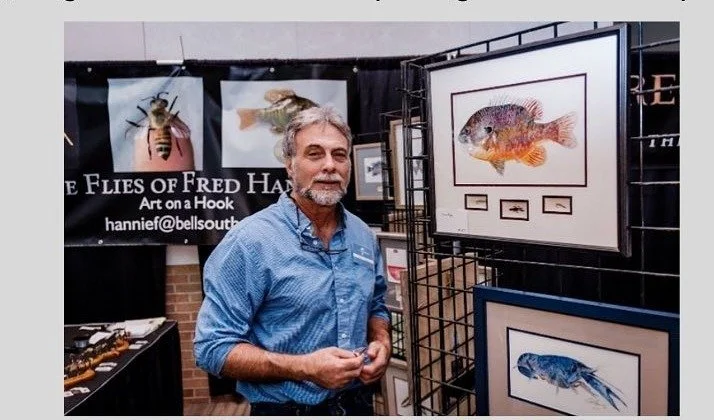
Fred Hannie at his "Flies of Fred Hannie — Art on a Hook" exhibit booth, framed fish art and his flies on display around him.
You're a professional artist who pioneered realistic tying with monofilament — how'd you get from art into tying flies that look alive, and when did mono become the material that clicked for you?
I'm actually a dental technician, at least that's where the majority of my income originates. I own and operate a dental lab where we make full and partial dentures. The skills required to create natural looking dentures transfer over to various types of art. I've been making dentures for over 40 years, so trust me when I tell you. Tying a fly for picky fish is far easier than making a denture for a picky client.
In the mid 2000s the internet blew up with forums. There were forums for every fishing related topic including realistic tying. I instantly knew this was something I wanted to do. The flies were insane! I was tying pan fish flies at the time using feather and fur and couldn't wrap my head around how some of these flies were tied. Turns out, a lot of them weren't. Some were sculpted, carved, painted and some had more glue than thread. Which is fine, but there were people like David Martin that could actually tie incredible flies that mimicked the actual insect. Through conflict on various forums we became allies and later friends. The conflict? There was a number of Europeans that believed that realistic flies didn't need a hook eye since they were art and not to be fished. I know, seems silly now but it was a "thing". David became my fly tying mentor. He was a former Taxidermist and that shaped his style of tying. To build the body of an insect he used a similar method to building bird body forms. To build a body form before premade forms were available taxidermists would wrap straw with twine. The majority of his flies had monofilament in place of a skeletal structure and they were fleshed out with deer hair and thread. He tied almost exclusively dry flies and the deer hair gave the flies their buoyancy. When I started to tie for my area I needed flies that were sub surface. The one fly that I had tried and failed to create for years was a grass shrimp. The grass shrimp is (by order of magnitude) the best live bait you could use for most fish on the gulf coast. I tried many patterns and countless materials until I realized how to manipulate monofilament to make the various parts of the shrimp. I became adept with solving different tying problems with mono to the point it became my "go to" material of choice. Everything from claws, legs, antennae and the list keeps growing.
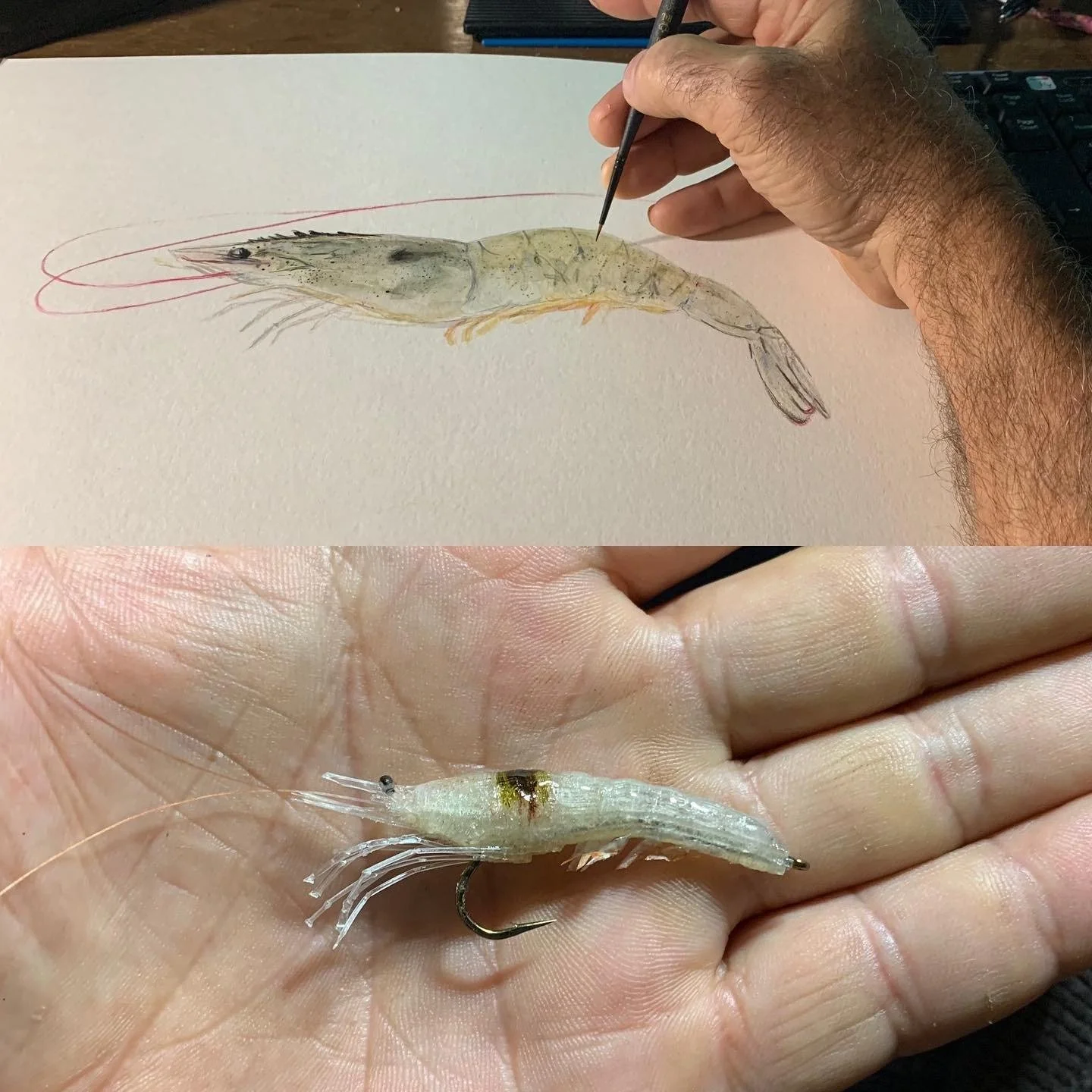
Top: Hannie's hand at work on a watercolor study of a Gulf white shrimp. Bottom: the finished shrimp fly resting in his palm — translucent segmented body, monofilament legs and antennae, the hook riding underneath.
Your recent work — the spent hopper, the Mexican tetra, those realistic / imitative patterns — when you sit down to tie one, are you tying it to actually fish it, to make as art, or both? And how do you know when the realism is actually fooling fish vs just looking right in hand?
The Mexican Tetra is not a tied fly but a fly rod lure. It was carved from a solid piece of dense foam and the fins are made with monofilament spines covered in tissue paper and head cement. To be honest more of these end up in frames than hit the water. It began as a concept to improve upon the popping bug. The first one I made was about an inch long and was a crippled golden shiner. I still fish that pattern today.
At this point I have tied every insect associated with fly fishing multiple times, but there are those I will always tie. Shrimp, honeybees and grasshoppers. This most recent hopper was inspired by a post on Facebook tying page. Someone posted a photo of this hopper and asked if anyone had a pattern for it. As a tying exercise I decided to try and see how close I could get to the photo.
All my flies and fly rod lures are conceived and constructed to hold up to the rigors of being fished. But ones intended to be fished and those tied to be displayed differ in their aerodynamics. The hopper with spent wings would be a beast to cast. The only difference between this hopper and one I would fish is wing positioning.
A good fly needs to be easy to cast, behave in or on the water like it's living counterpart and resemble something the fish would eat. The fly can be imitative or impressionistic but certain traits will give you an edge when the fish are feeding on a hatch. Size matters, color matters, profile matters. If you have a little creative ability these are achievable. It takes trial and error, experimentation to have an insect imitation sit on the water correctly. But nature shows us the way. I found if I duplicate the proportions correctly the body to buoyancy ratio has already been worked out. But in the end the fish are the ultimate judge.
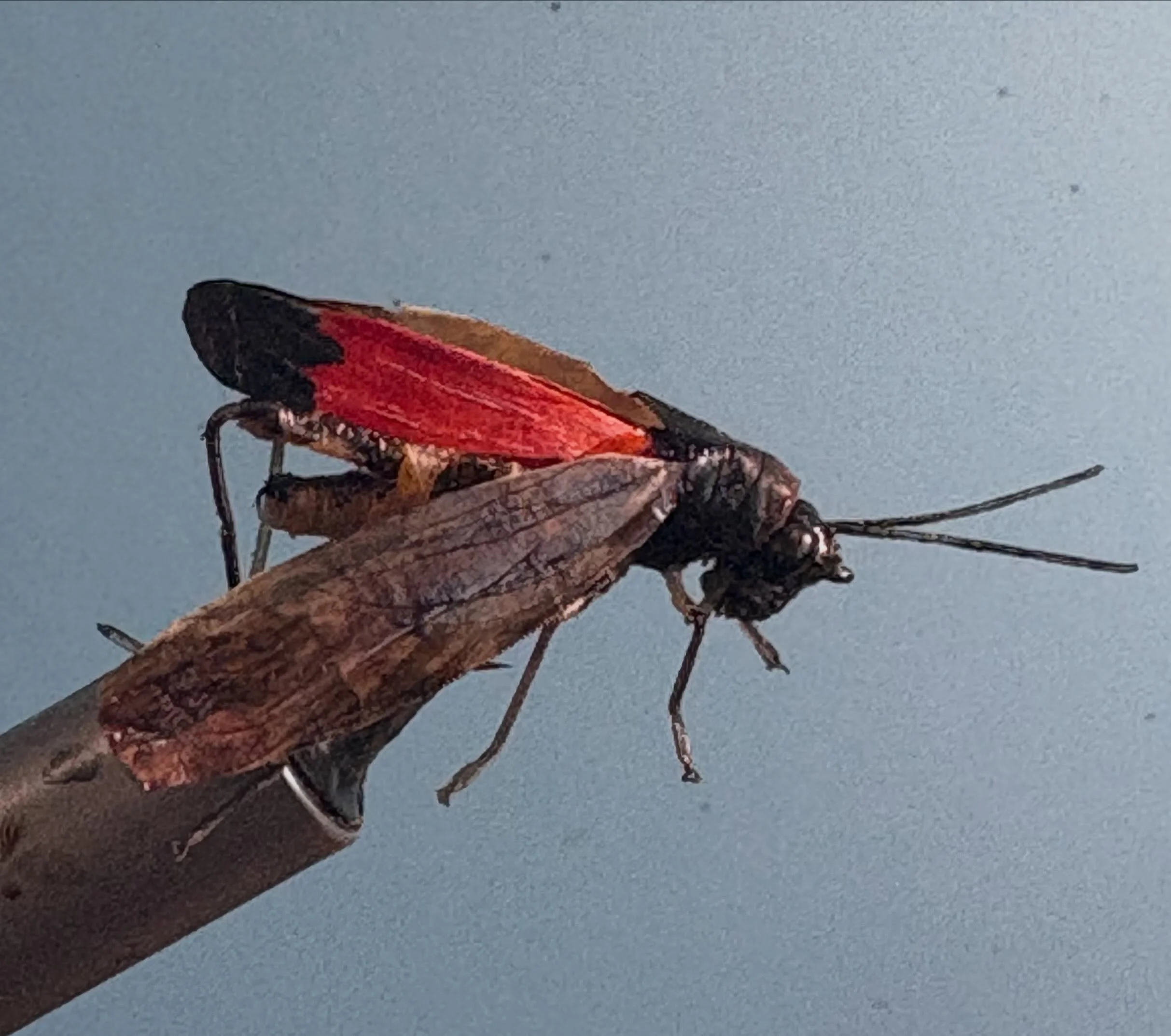
The spent hopper in the vise: black head and long antennae, a flash of red underwing under the spent wing laid flat. Hannie's fishing version of the same fly differs only in wing position.
You wrote the book on this — literally, Fly Tying with Monofilament in 2015 and Uncommon Flies in 2021. What are you working on now, and what do you want tiers who find your work to take away from it?
I am writing fly tying articles for a couple of print magazines. Also just completed a film prop. I was commissioned to create a one inch housefly to be used in an upcoming film. I tied it completely and then cut the hook off.
I currently serve on the Board of Governors of the FFI Fly Tying Group. I was involved in creating the Saltwater Skills Award program. The tier is given 10 patterns to choose from and must tie eight to pass and receive your certificate and pin. It is really good program that will get you proficient at tying these patterns. We chose the flies that would give the tier a broad understanding of material uses and techniques.
I have started a third book as yet untitled. As winter approaches I will be adding more videos to my YouTube channel.
It's my hope that tiers who find my work will discover use in the techniques they see. Don't shy away from attempting these patterns because you don't think you are artistic. An artist and engineer can both draw a straight line, one just uses a ruler.
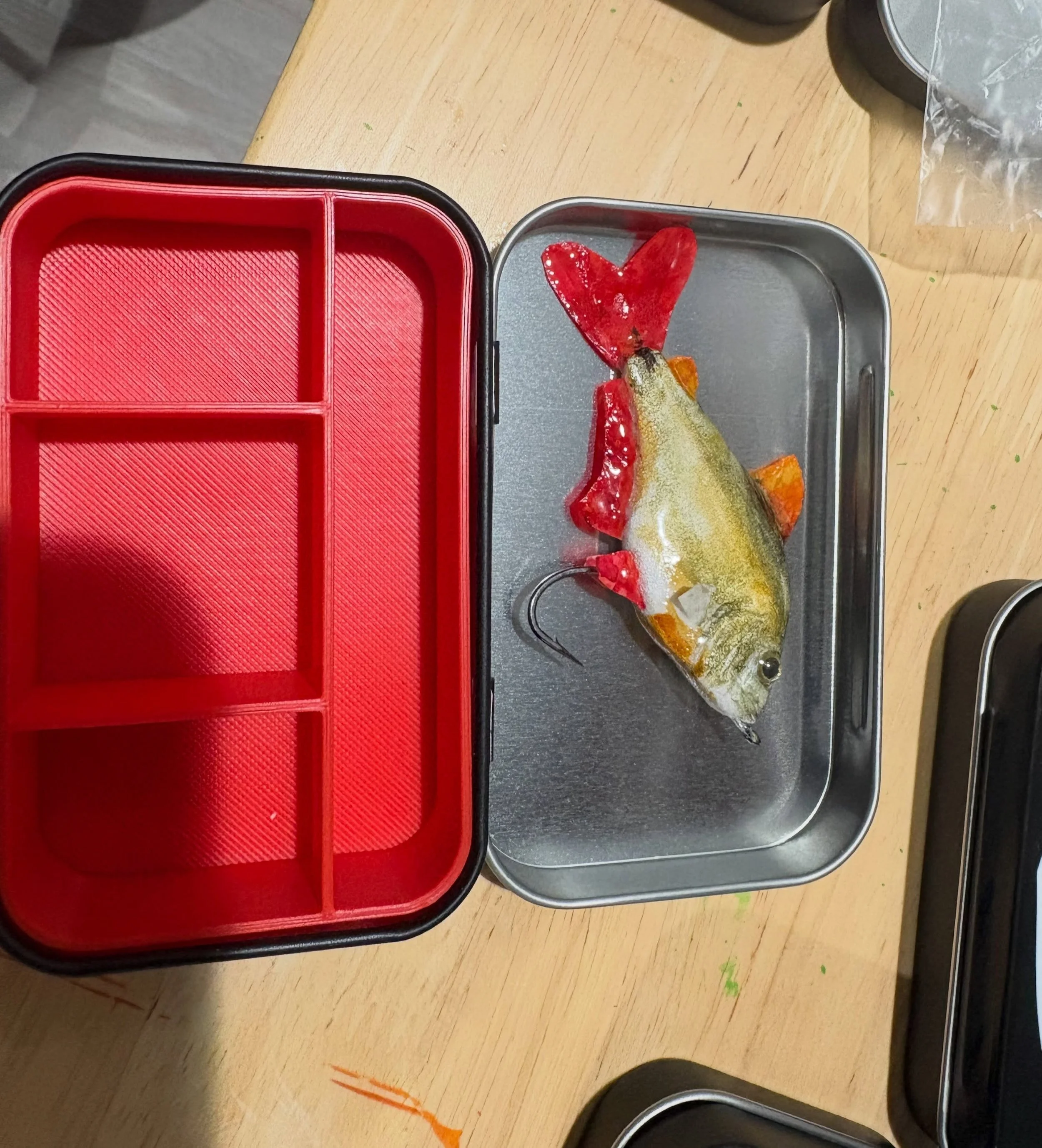
The finished Mexican tetra fly rod lure in its tin — carved foam body under the paint, translucent red-and-orange fins built on monofilament spines, and the hook underneath. More of these end up framed than fished.
The Fly Life take: Most realistic tying stops at the vise — it's sculpture that happens to involve a hook. Fred Hannie's never did. Forty years of dentures taught him to build things that look alive and hold up in use, and monofilament turned out to be the material that lets him do both: structure, legs, claws, antennae, all of it solved one tying problem at a time.
The other thing worth stealing from Fred isn't a pattern, it's the permission slip. Duplicate the proportions and nature has already worked out the buoyancy. Get the size, color and profile right and let the fish judge. As he puts it — an artist and an engineer can both draw a straight line. One just uses a ruler.
Find Fred on Instagram at @fred_hannie and on his YouTube channel, where he'll be adding tying videos as winter comes on. His books — Fly Tying with Monofilament and Uncommon Flies — are the deep end of this style for anyone who wants to go there.
